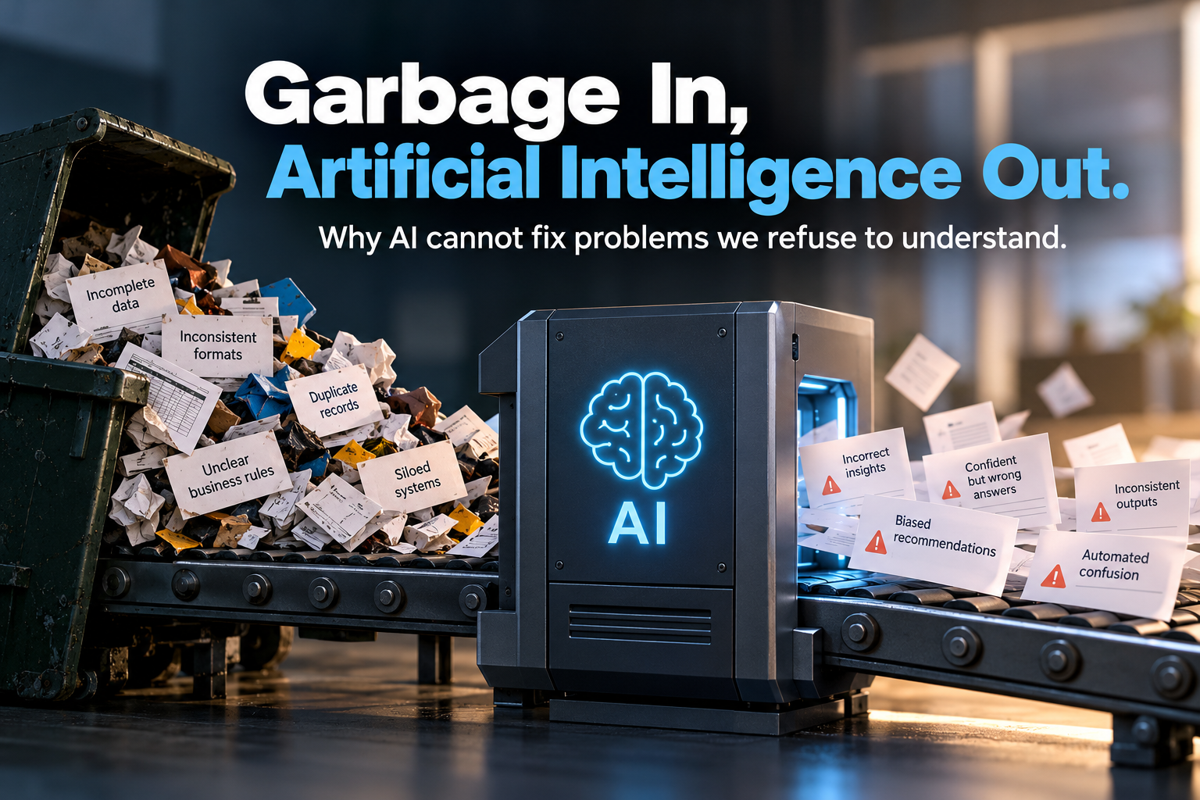
 Garbage In, AI Out: Are We Solving Problems or Hiding Them?
Why AI cannot fix problems we refuse to understand.
Artificial intelligence is becoming the answer to almost every business problem. Inefficient processes? Add AI. Poor data quality? Use AI to clean it. Employees spending too much time on manual tasks? Build an AI agent.
But how often do we stop to ask why these problems exist in the first place?
There is an old principle in computing: Garbage In, Garbage Out (GIGO). The idea is simple. If the information entering a system is unreliable, we shouldn't expect reliable results coming out of it.
We've known this for decades. Yet somehow, with the growing excitement around AI, we seem to be forgetting it.
AI Is Not a Substitute for Understanding
One of the things I've learned working as a solution designer across AI, analytics, data, and integrations is that technical problems are not always what they initially appear to be.
A failing integration might look like a software issue, but the actual problem could be inconsistent business rules, unclear data ownership, or two departments interpreting the same information differently.
A dashboard that doesn't support decision-making might appear to be an analytics problem, while the real issue is unclear definitions, unreliable source data, or a lack of agreement about which metrics matter.
Now imagine introducing AI into that environment.
The AI might help identify discrepancies, suggest corrections, automate decisions, or surface patterns in the data. It might even make the process appear more efficient.
But the underlying problem remains.
We've added another layer of technology to a process we never fully understood.
And that creates a dangerous situation: the system becomes more sophisticated without necessarily 
When AI Becomes a Band-Aid
Consider a company struggling with customer information across multiple systems.
Customer names are inconsistent, records are duplicated, and different departments maintain their own versions of the truth.
Someone proposes an AI solution to identify duplicates, standardize records, and reconcile the information automatically.
That sounds reasonable. And AI could genuinely help.
But what happens if nobody has defined which system owns the customer record? What if departments disagree about what constitutes a duplicate? What happens when the AI makes a decision that affects billing or reporting?
Without clear business rules, ownership, and governance, AI is being asked to make decisions the organization itself hasn't made.
Instead of fixing the underlying problem, we risk automating the confusion.
And because AI can produce convincing results, these issues may become harder to identify.
The Problem With Automating Something Broken
Automation has always carried a risk: it allows us to execute a process faster, including when that process is wrong.
AI introduces another dimension. Depending on how it's implemented, it can interpret information, generate responses, recommend actions, and make decisions with varying degrees of autonomy.
That makes understanding the original process even more important.
Imagine a purchasing workflow where approvals regularly take too long.
The immediate suggestion might be to introduce an AI agent to evaluate requests and accelerate approvals.
But why are approvals delayed?
Perhaps approval thresholds are poorly defined. Perhaps requests are missing essential information. Maybe the same purchase requires unnecessary reviews, or nobody knows who is responsible for the final decision.
An AI agent might reduce some of the manual work. But if the process itself is poorly designed, the organization could end up automating unnecessary steps while introducing additional cost and risk.
Sometimes the better solution is to simplify the workflow.
Sometimes it's to improve the data.
Sometimes it's to improve the analytics and make the right information available to the right people.
And sometimes AI is exactly the right tool.
The important part is understanding the problem before choosing the technology.

Why This Matters for AI Project Success
When an AI initiative fails to deliver the expected value, the technology itself is not necessarily the reason.
The model might perform well in testing. The integration might work. The application might even impress everyone during a demonstration.
But production environments introduce realities that demonstrations rarely capture.
Incomplete data. Conflicting business definitions. Exceptions that nobody documented. Processes that depend on informal knowledge. Responsibilities that were never clearly assigned.
AI doesn't automatically eliminate these problems.
In some cases, it makes them more expensive.
Now the organization has the original problem, plus model costs, monitoring requirements, validation processes, and another system to maintain.
This is why I believe insufficient understanding of the underlying business problem is one of the most important risks in AI initiatives and analytics solutions alike.
A successful technical implementation is not necessarily a successful business solution.
Start With the Problem, Not the Model
Before introducing AI, analytics, or any other technology into an existing process, I believe organizations should be able to answer a few basic questions:
- What problem are we actually solving? Identify the root cause rather than focusing exclusively on the visible symptoms.
- Why does the current process fail? Understand the data, business rules, dependencies, and exceptions.
- Can we solve it without AI? Sometimes a better integration, clearer ownership, improved analytics, or simpler workflow delivers more value.
- What specifically requires intelligence or analysis? Identify where interpretation, reasoning, pattern recognition, or handling unstructured information justifies using AI or advanced analytics.
- How will we know it works? Define measurable outcomes, acceptable error rates, costs, and accountability before implementation.
These questions aren't intended to discourage AI or analytics adoption. Quite the opposite.
They help identify where technology can provide genuine value rather than simply adding complexity.

The Real Opportunity
I believe AI and analytics have enormous potential, especially in data engineering, integrations, business automation, and decision support.
They can help organizations process information that previously required significant manual effort, identify patterns, improve visibility, and build capabilities that weren't economically practical before.
But the availability of powerful technology shouldn't replace good solution design and engineering judgment.
We still need to understand our systems, question assumptions, define ownership, establish meaningful metrics, and address the quality of the information we're working with.
Garbage In, Garbage Out hasn't disappeared.
We've simply developed more sophisticated ways to process the garbage.
And unless we address what goes in, we shouldn't be surprised when what comes out fails to deliver the value we expected.
This is also how I approach solution design. Before recommending a technology, I believe it's important to understand the business problem, identify its root causes, and evaluate what will actually deliver value.
If your organization is facing challenges with data quality, integrations, inefficient processes, or AI adoption, I'd be happy to connect and exchange ideas.


Carlos Alves
I’m Carlos, a Data Engineer and founder of 2BInformed. I focus on data engineering, system integrations, workflow automation, and the practical use of AI. Using SQL Server, Python, Dell Boomi, Fivetran, Snowflake, dbt, and n8n, I build reliable data pipelines, connect applications, improve data quality, and automate manual business processes. I’m also available for freelance projects involving integrations, automation, data solutions, workflow design, and technical consulting.


Comments (0)
Leave a Comment
No Comments Yet
Be the first to share your thoughts on this article!